Moving from fossil fuels to a knowledge-based economy is far from the only diversification strategy in play in the UAE.
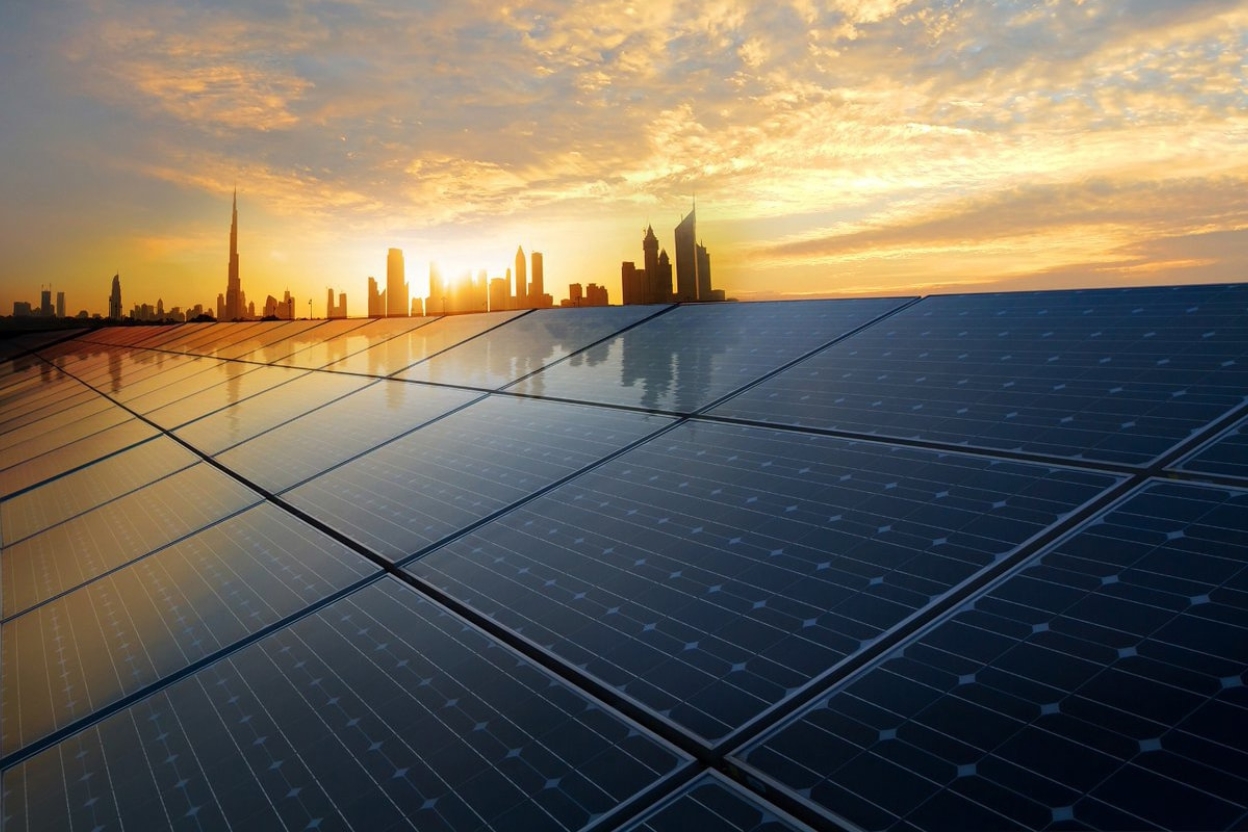
Within the energy sector, there is also a concerted attempt to balance carbon-heavy oil with sustainable resources via ambitious plans for renewable energy, particularly in solar and wind power.
The UAE has set long-term energy targets of achieving 50 per cent clean energy in the capacity mix by 2050, including a 6 per cent allocation for nuclear energy. A move than many environmentalists applaud as an example of a fossil fuel rich nation making a significant capital investment to reduce their carbon footprint.
This goal is supported by plans to achieve a 40 per cent reduction in energy demand by increasing energy efficiency.
“The UAE’s leadership has always supported sustainable development and created a council for the United Nations Sustainable Development Goals,” says UAE Minister of Energy, Suhail Mohammed Faraj Al Mazrouei.
“Diversification is the keyword which featured in our energy strategy formulation. The key to the security of supply is the balance of fossil fuel technologies and clean energy sources. Therefore our energy mix includes gas, coal, nuclear, solar as well as wind and waste to energy.”
“We see that economic development with the ethos of sustainability embedded in the practices of the government and private sector will be beneficial for the nation in the future.”
A prime example is the Masdar City project in Abu Dhabi. Being built by Masdar, a subsidiary of Mubadala Development Company, with seed capital from the Abu Dhabi government, it claims to be the world’s most sustainable urban community.
Within five years, Masdar City expects to be home to 11,000 residents, with another 11,000 people working and studying there. More than 550 organisations including the International Renewable Energy Agency (IRENA), Emirates Nuclear Energy Corporation and Siemens, are already based in the development.
The focus is on sustainability. This year, Masdar unveiled the Etihad Eco-Residence, Abu Dhabi’s first purpose-built, LEED-Platinum-rated cabin crew accommodation rated platinum under the Leadership in Energy and Environmental Design green building rating system.
To attract more small businesses specialising in clean technology and sustainability, Masdar has relaunched The Catalyst, the region’s first clean technology start-up accelerator, which provides funding and mentorship.
Buildings within Masdar City are designed to reduce energy and water consumption by at least 40 per cent in accordance with Estidama guidelines.
Last year, Masdar launched the Eco-Villa, a pilot project conceived as a template for affordable and highly energy- and water-efficient residential villas in the UAE, which uses around 72 per cent less power and 35 per cent less water than a typical dwelling in Abu Dhabi, while displacing an estimated 63 tonnes of carbon dioxide annually.
Masdar partnered with ADNOC to develop the world’s first commercial-scale carbon capture utilisation and sequestration facility and is working with ADNOC Distribution to form a hydrogen fuelling station at Masdar City.
This year Masdar published the findings of its Renewable Energy Desalination Pilot Programme partnership, concluding that solar energy powered desalination is a commercially viable option for the UAE.
Masdar City already ranks as one of the UAE’s largest clusters of high-tech businesses focusing on sustainable technologies.
It says it is committed to continuing to expand on its existing pipeline of innovative demonstration facilities, where sustainable technologies from solar renewable energy, batteries and electric mobility networks to biofuels, recycling, and sustainable agriculture are piloted and implemented.
“Masdar City is demonstrating the economic viability of sustainable real estate by adopting commercially viable solutions in the reduction of energy and water demand and waste,” says Masdar chief executive Mohamad Jameel Al Ramahi.
“We are driving clean-tech innovation through the deployment of advanced clean technologies at scale.”
Masdar, which has renewable energy projects in more than 20 countries, is also developing the GCC’s first large-scale wind farm in Oman and the UAE’s first waste-to-energy plant in Sharjah.
In 2016, a Masdar-led consortium set a record-low price for solar power generation to develop the third 800-megawatt phase of the Mohammed bin Rashid Al Maktoum Solar Park in Dubai.
“Sustainability is in the DNA of the UAE,” adds Mr Al Ramahi. “The UAE’s founding father, Sheikh Zayed Al Nahyan, recognised the importance of environmental stewardship early on. Sustainable development is therefore fundamental to the long-term prosperity of the UAE.”
It may still come as a surprise to observers who have long viewed the nation’s natural carbon reserves as ephemeral.
However, the development of sustainable resources, if administered and managed adroitly, could transform the way the UAE is perceived internationally as well as positioning the nation at the heart of the global sustainability movement.
Abu Dhabi refines downstream production
With so many geopolitical headwinds in play potentially affecting global oil prices, the new strategy of the Abu Dhabi National Oil Company (ADNOC), is being viewed as a highly complex plan that also involves marketing risks, but it could potentially unlock new value for the UAE in downstream oil and gas production.
Aimed at creating and maximising value and ensuring smart growth in ADNOC’s upstream and downstream businesses, while strengthening access to the overall market, it will involve an investment of more than Dh400 billion ($109bn) on a series of expansion and growth projects over the next five years.
ADNOC, the national oil company of the UAE, is increasing daily production capacity from 3.3 million barrels of oil to 3.5 million barrels by the end of 2018.
It also plans to explore and appraise Abu Dhabi’s unconventional gas resources and pursue international investments positioning it as a global player in the downstream market.
Founded in 1971 -12 years after oil was discovered in the UAE at the Murban Bab oil field following a 30-year search – ADNOC has always seen itself as a long-term, reliable supplier of crude.
However, the new strategy also aims to position the company on a new track of value creation, designed to stretch the margin on every barrel of oil it produces through downstream investment in the long-term market growth of refined and petrochemical products, particularly from non-OECD countries.
Dr Sultan Ahmed Al Jaber, UAE Minister of State and ADNOC director-general and chief executive, says: “Creating a more valuable downstream business will allow ADNOC to become a more flexible, resilient and diverse energy company, ensuring it remains an integral part of the UAE economy and prosperity.”
A major focus will be on a $45 billion expansion of the assets, capabilities and product range of the Ruwais Industrial Complex, transforming it into the world’s largest, fully-integrated refining and petrochemicals complex.
ADNOC will expand the Ruwais complex’s refining capacity by more than 65 per cent, or 600,000 barrels per day, by 2025 through the addition of a third, new refinery, creating a total capacity of 1.5 million barrels per day.
It will also develop a new, large-scale, manufacturing ecosystem through the creation of petrochemical derivatives and conversion parks that it wants to act as catalysts for the next stage of petrochemical transformation by inviting partners to invest and produce new products and solutions.
Meanwhile, the Ruwais Conversion Park is aimed at spurring business creation further down the value chain, taking feedstock from both the Derivatives Park and other Ruwais assets, to manufacture higher-value end products, including packaging materials, coatings, high voltage insulation and automotive composites.
“The strategy will be executed through a select number of long-term partners,” says Dr Al Jaber. “Importantly, they will be partners in growth, not merely assets or capital.” ADNOC’s proposition to them is clear: invest in the UAE, to access global growth. Invest local, grow global.
“Partners who bring finance, technology or market access to the partnership will, in turn, benefit from ADNOC’s reach and market influence.”
A particular focus of ADNOC’s downstream strategy is a forecast doubling of demand, from Asia for products across the petrochemical value chain.
To help meet this demand, ADNOC will triple production of petrochemicals to 14.4 million tonnes a year by 2025.
Dr Al Jaber says ADNOC’s goal is to shift to become not only a ‘producer’ but also a customer-focused marketer of energy. However, this will mean investment in employees as well as natural resources.
He states: “The UAE’s most precious resource lies not in the ground, or under the sea, but in its people and the nation’s long-term economic prosperity will be founded on world-class human capital.
“In line with the leadership’s directives, ADNOC is unlocking the potential of its national workforce and setting a best-practice benchmark.
“It is investing heavily in up-skilling its Emirati talent to give them the tools to succeed, including better training and greater mobility within the organisation, which will present rewarding career opportunities for current and future employees.
“Overall, ADNOC’s goal is to make its national workforce smarter, highly skilled and competitive, as it continues to create a more commercially minded and performance driven organisation.”
ADNOC believes strategic partnerships and investment can build a manufacturing ecosystem in Ruwais that will significantly stimulate in-country value creation, private sector growth and employment.
The strategy is a central pillar of a national economic development plan designed to secure the UAE’s future prosperity of the nation by adding more than 15,000 direct and indirect specialised jobs by 2025 and contributing an additional 1% to annual GDP.
UAE Minister of Energy Suhail Mohammed Faraj Al Mazrouei believes the plan is the way forward for ADNOC and the nation.
“The company is in a very active phase of exploration, growth and development and will advance and then bring on-stream a number of new oil and gas projects in the years ahead,” he says.
As the UAE’s largest energy provider, ADNOC possesses a uniquely-integrated upstream-downstream value chain with secure, competitive access to high-quality feedstock, underpinned by world-scale assets and operations.
Its open and flexible operating model is also a competitive advantage. However, the real test of the new strategy will be whether ADNOC is ready after five decades of international partnership experience for a strategic shift that will position it for the next phase of development.
Developing its human capital and directing a path through global market dynamics may prove a harder challenge than delivering the technological advancements, but the prize is a more diversified, higher-value operation that holds the promise of long-term stability and growth.