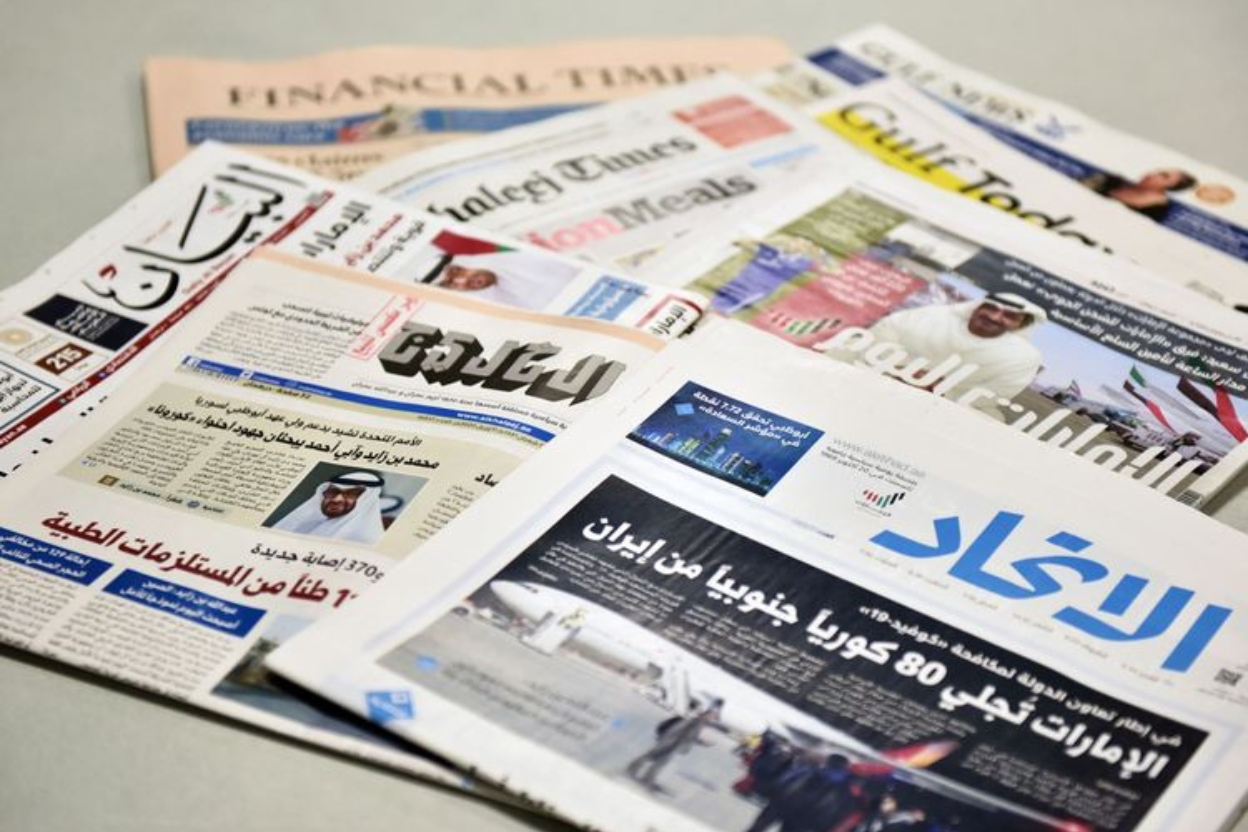
A New World for Media

Facebook
Twitter
LinkedIn

A New World for Media

Over the past four years, the UAE has been impacted by geopolitical tensions and challenges including a decline in the performance of the global economy, slowing global trade and uncertainty over world economic policies.

SPONSERED BY

By Daniel Lee

Over the past ten years, the UAE has built a thriving media ecosystem and sustainable media economy, attracting more than 470 companies, including major names such as Sky News Arabia and CNN.

The UAE provides over 700 diverse filming locations to choose from and has invested in state-of-the-art infrastructure, attracting the world’s leading studios with incentives including a 27 per cent rebate on production spend from Abu Dhabi Film Commission.

In Abu Dhabi, twofour54 has been created as a media zone that is about much more than just property…It helps firms to secure business and talent via a briefing room connecting them with live briefs, networking events, production and post-production facilities and a 13,000-strong youth community providing local insights and feedback.

Abu Dhabi has also established a robust and multilingual freelance pool with more than 580 freelancers.  Current initiatives include expansion of twofour54’s new Studio City at Mina Zayed, which will cover 300,000 sqm and feature an outdoor film set, a permanent backlot and an assortment of studios.

Abu Dhabi is also focusing on attracting more local, regional, and international productions.  This year has seen the shooting of Salman Khan’s action movie Race 3, South Indian film Saaho and Hollywood blockbuster Mission: Impossible – Fallout.

Noting that Abu Dhabi contributes 65 per cent of the UAE’s economy and is the wealthiest emirate in terms of GDP and per capita income, Maryam Al Mheiri,  twofour54 chief executive, says: “We want Abu Dhabi to be the region’s first choice for film-makers, animators, games creators, digital entrepreneurs, publishers, writers and all other media organisations, so there has never been a better time to set up home in Abu Dhabi.” 

Abu Dhabi sees a significant opportunity for brands to create quality Arabic content and twofour54, has entered into production partnerships with brands including O3 Productions and Discovery Communications.

The latest partnership with the Department of Economic Development allows firms in the media free zone to connect with the government sector by applying for a special branch license in addition to their existing free zone license, without the need to have a second additional onshore office or premises.

Production house Media Mania and creative communications agency All About Brands were among the first firms to receive branch licenses and both say they have opened new doors for them.

Continued inward foreign media investment is a priority with Abu Dhabi, determined to capitalise on the Middle East and North Africa as being one of the fastest growing media markets globally – predicted by accountants PricewaterhouseCoopers to grow by 7.4% between 2016-2020. 

The UAE government reached an agreement for Arab Satellite Telecommunication Organization (Arabsat) to launch a new set of satellite TV channels on the Arabsat Badr-4 satellite. 

Arabsat offers twofour54 partners and broadcasters across the region the ability to distribute content to a sizeable audience directly from the free zone, providing more than 500 TV channels, 200 radio stations, pay-TV networks and HD channels to tens of millions of homes in more than 80 countries across the Middle East, Africa and Europe. 

During a period when there is intense scrutiny in the West on the openness and transparency of Arab media, this kind of growth is attractive but also brings potential cultural and political risks.  The continued expansion of the UAE’s media sector will, therefore, depend to some degree on balancing these tensions, both at home and with its Arab neighbours. 

Article Two: Nurturing the shoots of agriculture

By Andrew Cave

Sustainable agriculture is a buzz phrase across the globe, but few places are as challenging to make it a 21st Century reality as the Gulf.

The hot and dry environment, water shortages and a dearth of arable land combine to make the region one of the toughest in the world to turn the rhetoric and promises into actual living practice.

When these environmental factors are combined with statistics showing that the UAE imports up to 85 per cent of its food and forecast that the nation’s population will grow by more than 20 per cent to 11million by 2030, the scale of the task becomes even more daunting.

After recent progress, the UAE now boasts more than 50 per cent self-sufficiency in eggs production and 70 per cent in fresh milk.  Recent increases in agricultural production have not kept pace with growth in consumption but project trials are underway that may make a serious contribution to achieving sustainable farming goals.  Low-water farming using hydroponic technology could reduce the need for fruit and vegetable imports, while smarter production methods can also use up to 90 per cent less water than conventional means.

As the use of water in agriculture accounts for about four-fifths of the UAE’s total water usage, this could have significant consequences not just for agrarian industry but the economy as a whole.  By reducing food imports, smart production of domestic food could also reduce the UAE’s carbon footprint – one of the highest per capita in the world.

Other projects are trialling saline and dry condition agriculture, irrigation technologies and cultivation methodologies, which could all help raise production levels with reduced environmental impact.  When put into practice, all this can benefit the country and region in terms of increased production with reduced input.

In Dubai, the International Centre for Biosaline Agriculture (ICBA) is using modern irrigation systems and net houses to increase environmental controls and improve yields, compared to open fields.

Other methods include using treated wastewater for crop irrigation, growing crops such as quinoa with high-saline water and reviving salt-affected farms by growing climate-resilient and salt-tolerant halophyte plants. 

Over the next three years, Abu Dhabi Food Control Authority (ADFCA) has some schemes in place to control plant pests and diseases, expand the use of alternative irrigation sources and convert targeted farms to use treated wastewater.

It also wants the agricultural sector to become increasingly self-managed, including plans to enable the production of honey from approved local bee species and looking at biosecurity and regional animal production strategies.

In biosecurity, ADFCA has deployed an electronic surveillance programme to detect diseases and epidemics and has started tracking the movement and changes of animals through the animal identification and registration system.

ADFCA has also developed an integrated electronic program to manage subsidiaries including the electronic feed-support program efficiently. 

Saeed AlBahri Salem Al Ameri, ADFCA director-general, says: “With the advancement of agricultural technology and food science, it is possible that big steps can be taken towards improving self-sufficiency in the UAE.”

ADFCA has formed an investment committee that has identified 15 essential areas of investment in food and agriculture and has the mandate to encourage public-private partnerships in these areas.

Success here is likely to depend upon maintaining a favourable environment for foreign investors.

While there is always likely to be a residual level of imported food, the focus going forward will place a heavy emphasis on achieving a much more equal balance between domestic production and imported food.

Tags:

What do you think?

UAE is diversifying to win in the global economy. It is a pivotal time for
The UAE reinforces itself as an investment destination of choice as it transitions into a

By Daniel Lee

Over the past ten years, the UAE has built a thriving media ecosystem and sustainable media economy, attracting more than 470 companies, including major names such as Sky News Arabia and CNN.

The UAE provides over 700 diverse filming locations to choose from and has invested in state-of-the-art infrastructure, attracting the world’s leading studios with incentives including a 27 per cent rebate on production spend from Abu Dhabi Film Commission.

In Abu Dhabi, twofour54 has been created as a media zone that is about much more than just property…It helps firms to secure business and talent via a briefing room connecting them with live briefs, networking events, production and post-production facilities and a 13,000-strong youth community providing local insights and feedback.

Abu Dhabi has also established a robust and multilingual freelance pool with more than 580 freelancers.  Current initiatives include expansion of twofour54’s new Studio City at Mina Zayed, which will cover 300,000 sqm and feature an outdoor film set, a permanent backlot and an assortment of studios.

Abu Dhabi is also focusing on attracting more local, regional, and international productions.  This year has seen the shooting of Salman Khan’s action movie Race 3, South Indian film Saaho and Hollywood blockbuster Mission: Impossible – Fallout.

Noting that Abu Dhabi contributes 65 per cent of the UAE’s economy and is the wealthiest emirate in terms of GDP and per capita income, Maryam Al Mheiri,  twofour54 chief executive, says: “We want Abu Dhabi to be the region’s first choice for film-makers, animators, games creators, digital entrepreneurs, publishers, writers and all other media organisations, so there has never been a better time to set up home in Abu Dhabi.” 

Abu Dhabi sees a significant opportunity for brands to create quality Arabic content and twofour54, has entered into production partnerships with brands including O3 Productions and Discovery Communications.

The latest partnership with the Department of Economic Development allows firms in the media free zone to connect with the government sector by applying for a special branch license in addition to their existing free zone license, without the need to have a second additional onshore office or premises.

Production house Media Mania and creative communications agency All About Brands were among the first firms to receive branch licenses and both say they have opened new doors for them.

Continued inward foreign media investment is a priority with Abu Dhabi, determined to capitalise on the Middle East and North Africa as being one of the fastest growing media markets globally – predicted by accountants PricewaterhouseCoopers to grow by 7.4% between 2016-2020. 

The UAE government reached an agreement for Arab Satellite Telecommunication Organization (Arabsat) to launch a new set of satellite TV channels on the Arabsat Badr-4 satellite. 

Arabsat offers twofour54 partners and broadcasters across the region the ability to distribute content to a sizeable audience directly from the free zone, providing more than 500 TV channels, 200 radio stations, pay-TV networks and HD channels to tens of millions of homes in more than 80 countries across the Middle East, Africa and Europe. 

During a period when there is intense scrutiny in the West on the openness and transparency of Arab media, this kind of growth is attractive but also brings potential cultural and political risks.  The continued expansion of the UAE’s media sector will, therefore, depend to some degree on balancing these tensions, both at home and with its Arab neighbours. 

Article Two: Nurturing the shoots of agriculture

By Andrew Cave

Sustainable agriculture is a buzz phrase across the globe, but few places are as challenging to make it a 21st Century reality as the Gulf.

The hot and dry environment, water shortages and a dearth of arable land combine to make the region one of the toughest in the world to turn the rhetoric and promises into actual living practice.

When these environmental factors are combined with statistics showing that the UAE imports up to 85 per cent of its food and forecast that the nation’s population will grow by more than 20 per cent to 11million by 2030, the scale of the task becomes even more daunting.

After recent progress, the UAE now boasts more than 50 per cent self-sufficiency in eggs production and 70 per cent in fresh milk.  Recent increases in agricultural production have not kept pace with growth in consumption but project trials are underway that may make a serious contribution to achieving sustainable farming goals.  Low-water farming using hydroponic technology could reduce the need for fruit and vegetable imports, while smarter production methods can also use up to 90 per cent less water than conventional means.

As the use of water in agriculture accounts for about four-fifths of the UAE’s total water usage, this could have significant consequences not just for agrarian industry but the economy as a whole.  By reducing food imports, smart production of domestic food could also reduce the UAE’s carbon footprint – one of the highest per capita in the world.

Other projects are trialling saline and dry condition agriculture, irrigation technologies and cultivation methodologies, which could all help raise production levels with reduced environmental impact.  When put into practice, all this can benefit the country and region in terms of increased production with reduced input.

In Dubai, the International Centre for Biosaline Agriculture (ICBA) is using modern irrigation systems and net houses to increase environmental controls and improve yields, compared to open fields.

Other methods include using treated wastewater for crop irrigation, growing crops such as quinoa with high-saline water and reviving salt-affected farms by growing climate-resilient and salt-tolerant halophyte plants. 

Over the next three years, Abu Dhabi Food Control Authority (ADFCA) has some schemes in place to control plant pests and diseases, expand the use of alternative irrigation sources and convert targeted farms to use treated wastewater.

It also wants the agricultural sector to become increasingly self-managed, including plans to enable the production of honey from approved local bee species and looking at biosecurity and regional animal production strategies.

In biosecurity, ADFCA has deployed an electronic surveillance programme to detect diseases and epidemics and has started tracking the movement and changes of animals through the animal identification and registration system.

ADFCA has also developed an integrated electronic program to manage subsidiaries including the electronic feed-support program efficiently. 

Saeed AlBahri Salem Al Ameri, ADFCA director-general, says: “With the advancement of agricultural technology and food science, it is possible that big steps can be taken towards improving self-sufficiency in the UAE.”

ADFCA has formed an investment committee that has identified 15 essential areas of investment in food and agriculture and has the mandate to encourage public-private partnerships in these areas.

Success here is likely to depend upon maintaining a favourable environment for foreign investors.

While there is always likely to be a residual level of imported food, the focus going forward will place a heavy emphasis on achieving a much more equal balance between domestic production and imported food.

Tags:

What do you think?

Related Insights